
When I look at history, I always like to rewind things back to the start. With Ancient Egypt, it’s no different. I’ve been on this journey for a while now, trying to trace the dynasties and the timeline, organizing things as best as I can. Now I’m still on this quest, but as I bring some of my research to the people, I wanted to start at the earliest known periods that connect directly to the Nile Valley.
So this brings us to the Paleolithic period, also called the Old Stone Age. It runs from roughly 2.6 million years ago, when the first stone tool industries show up, to about 11,700 years ago. Some researchers push the start back to 3.3 million years based on the Lomekwi tools in Kenya. From my research, this is the stretch when people began moving into what would later become Ancient Egypt.
Before We Start
Two things to keep in mind.
BCE means Before Common Era, counting backwards from year zero. 5000 BCE is 7,000 years ago. BP means Before Present, counting backwards from now. Scientists use BP, historians usually use BCE, and that alone causes arguments.
Second, a single archaeological site can hold art and objects separated by ten thousand years. A cliff face in the Sahara is not a photograph from one day. It is more like a wall that people kept painting on, on and off, for a hundred centuries…allegedly.
The Green Sahara
The Sahara has not always been a desert. 14,800 to 5,500 years ago (about 12,800–3,500 BCE), North Africa went through the African Humid Period. Thats when rains pushed north, and what is now a hot desert (largest on earth) use to be grassland, woodland, rivers and lakes big enough to hold hippos and crocodiles.
People lived out there. Not passing through, living there! Hunting, fishing, and later herding cattle across country that is now bare rock and sand. One study using 3,287 radiocarbon dates from 1,011 different archaeological sites tracked a population boom across northern Africa between 10,500 and 5,500 years ago, matching the green period almost exactly.
Then it ended, and fast! The drying took roughly a thousand years and was complete by about 3,500 BCE. When the water went, the people had to go somewhere. Because humans need water to survive. And guess where the nearest permanent water in the region was…the Nile!
Migration and Connections
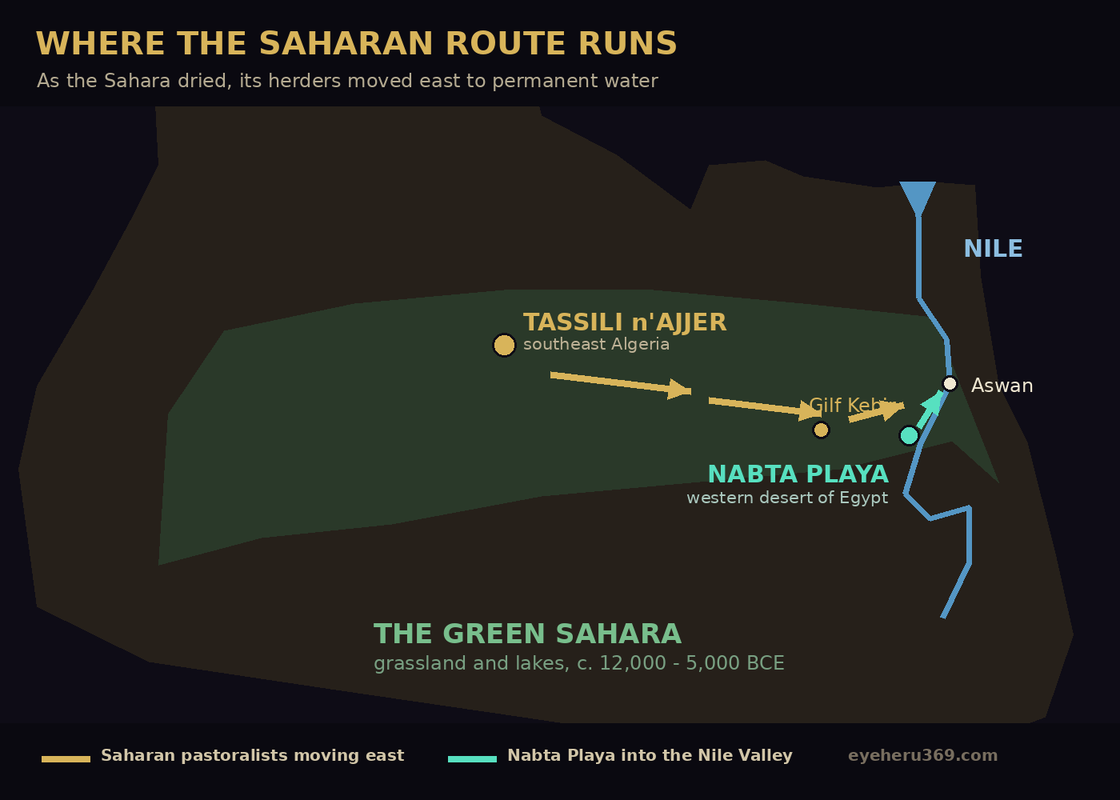
The theory is that climate change forced groups to move from the Sahara toward the Nile, and they brought their tools and traditions with them. There are really two separate movements here, and it matters that we keep them apart, because people argue past each other constantly by mixing them up.
One runs west to east. Saharan herders walking toward the river as their homeland dried out. That is the movement in map 01.1 above. The other runs south to north. Up the Nile corridor itself, out of what is now Sudan into Egypt. That is the movement in map 01 below. Both fed the Nile Valley. They are not the same thing, and the Nile Valley got people from both directions…allegedly.

One Rock Face, Ten Thousand Years
This is the part I had to correct in my own understanding, and I want to lay it out because almost nobody explains it.
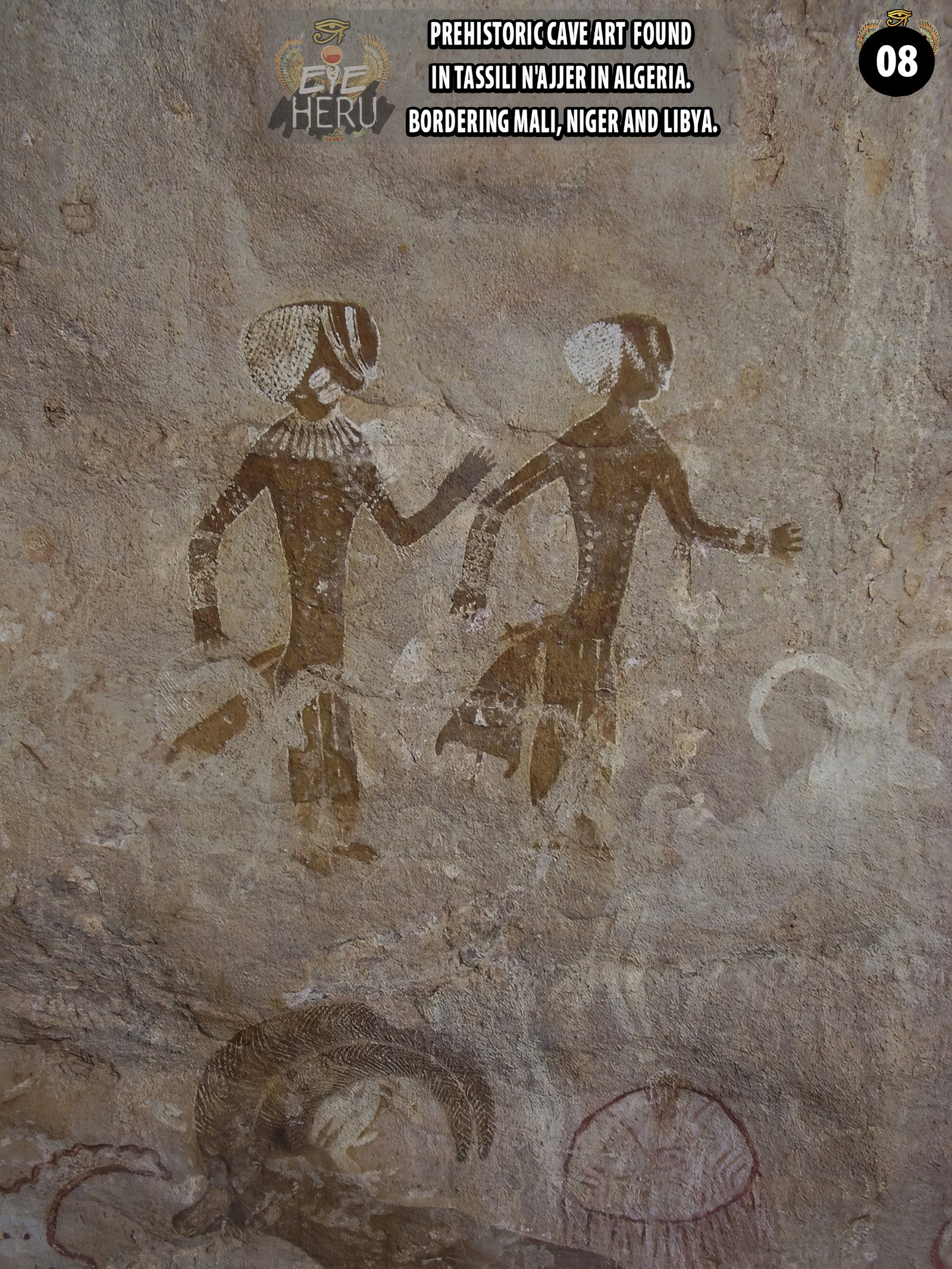
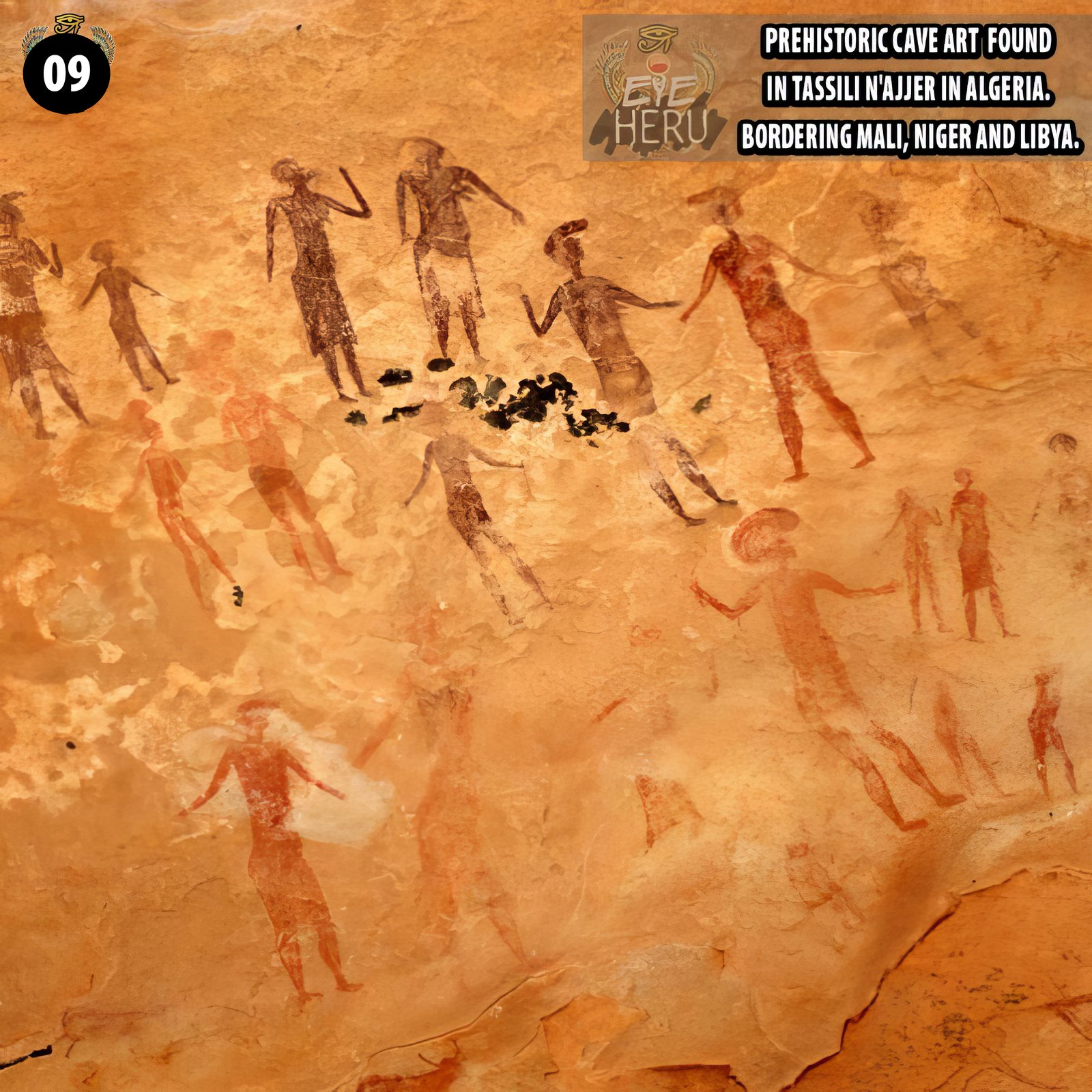
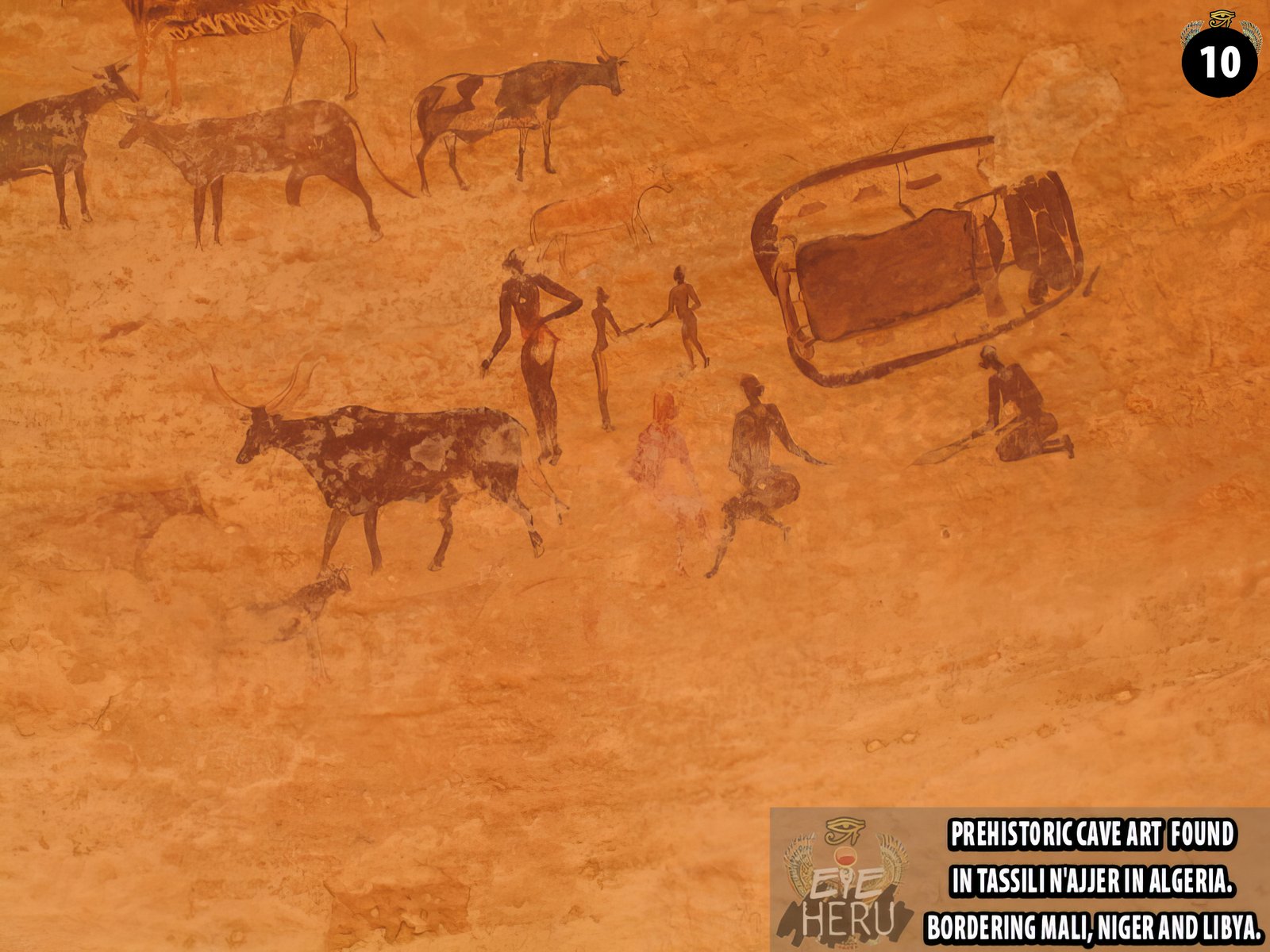
The rock and cave art at Tassili n’Ajjer in southeast Algeria is not one body of work made by one people at one time. It was made across roughly ten thousand years, by different populations, in at least four distinct traditions that researchers claim to tell apart by style, subject and technique. When you look at a gallery of Tassili images, you are looking at art separated by more time than separates us from the building of the pyramids. Now keep in mind, this is all in theory. A theory based in logic, but theory none the less.
The four traditions at Tassili n’Ajjer
- c. 10,000–6,000 BCEWild Fauna / Archaic
- The oldest layer. Big game that no longer exists in the region: the giant buffalo Bubalus antiquus, elephants, hippos, crocodiles. Proof on its own that this was wet country.
- c. 8,000–6,000 BCERound Head
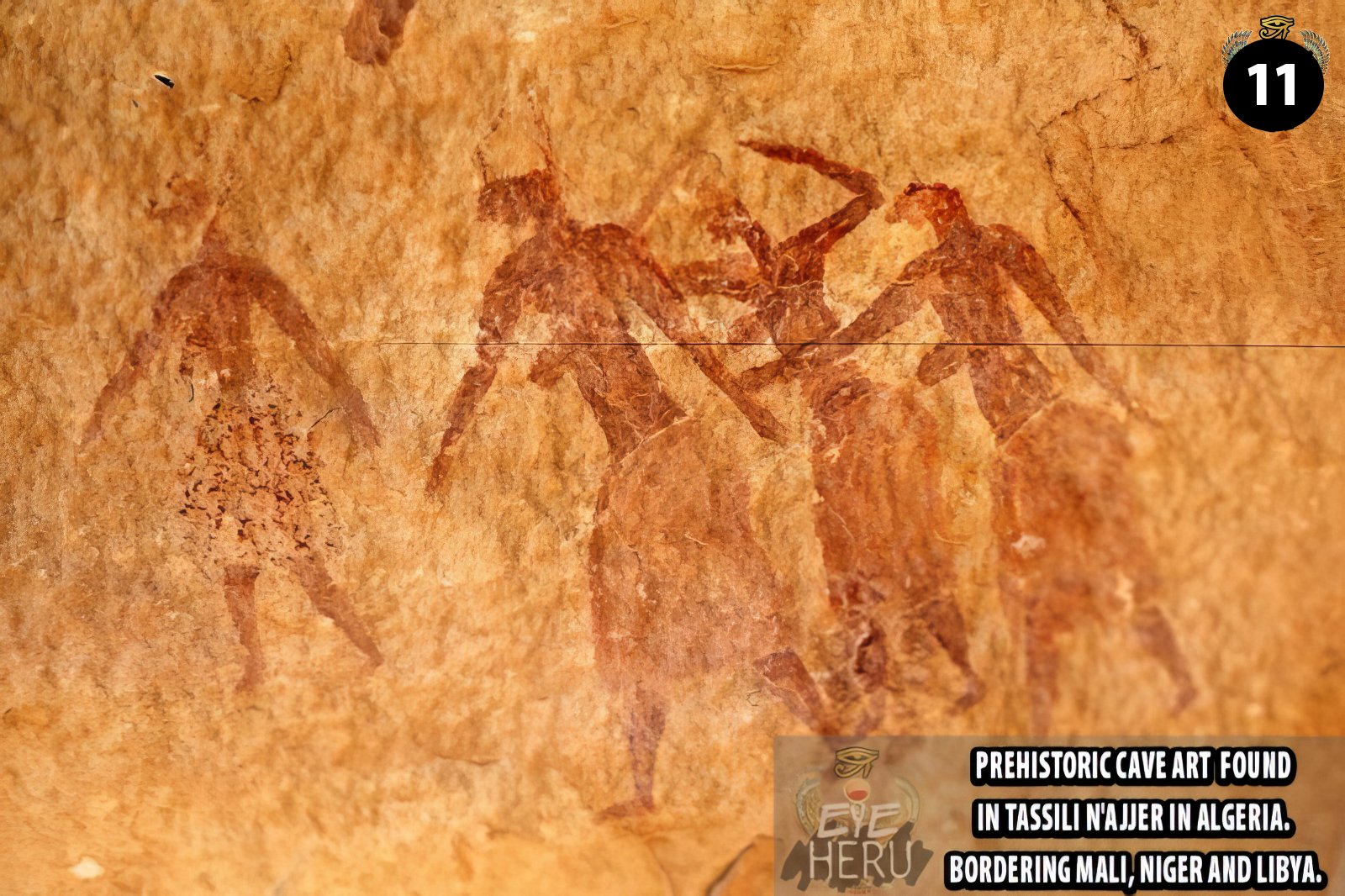
- The famous one. Tall human figures with large featureless round heads, often seeming to float. Ceremonial, masked, strange. This is the tradition people usually mean when they talk about Tassili.
- c. 5,000–2,500 BCEPastoral / Bovidian
- The largest body of work by volume. Cattle herds, milking, camp life, daily scenes rendered naturalistically. Herding people at the height of the green period.
- c. 2,000–1,000 BCE onwardHorse
- Horses arrive, and with them chariots. This is thousands of years after the Round Head painters were gone.
- c. 100 BCE onwardCamel
- The camel appears and the trans-Saharan trade era begins. The desert is fully desert by now.
So when I said earlier that this art “dates back about 12,000 years,” that is true of the oldest layer only. That oldest layer sits right at the end of the Paleolithic, at the opening of the Green Sahara. Everything after it belongs to later worlds.

These paintings show rituals, hunting, and cattle herding. Even the dyes and techniques used are similar to what we find in early Nile sites. That connection supports the theory of migrating Saharan groups contributing to the roots of Egyptian culture.

The Bow: Nubia and Egypt
Looking at the cave art, we see figures with bows and arrows. I find this interesting because the image immediately reminded me of Nubian culture. They were expert archers. #teamSagittarius

And this is not just my read on it. The Egyptians named Nubia after the bow. Their word for the land to their south was Ta-Seti, meaning “Land of the Bow.” It was also the name of the first nome, the first administrative district of Upper Egypt. When your neighbor names an entire country after your weapon, that tells you how vicious they must of been with that bow! »┼)➝
Remember in the tomb of Mesehti, a governor at Asyut in the 11th Dynasty (c. 2130-1991 BCE), they found a model company of Nubian soldiers holding bows. The model dates to around 2040 BCE and it is in the Egyptian Museum in Cairo today.

At this time Nubians were serving inside Egyptian forces as archers and mercenaries, which is exactly why a governor is buried with a bunch of little Nubian figures. It was not a unification of the two states, though. Egypt did not annex Lower Nubia until the 12th Dynasty, under Senusret I and later Senusret III. Eventually things turned sour and they started beefing. To this day I am curious what caused the issues between these two great nations.

The shapes of the bows and arrows and even the elongated head shapes in some figures (images 03 and 14) feel familiar to me. According to the current evidence, this art could represent the earliest remnants of a civilization that helped lay the cultural foundation for King Narmer and the 1st Dynasty around 3100 BCE.
The Chariot Question

One standout piece shows a figure riding what resembles a chariot. This immediately made me think of King Tut’s chariot, which I saw at the exhibit in Washington, DC.
Look at image 16 and the resemblance is not vague. Both are light two-wheeled vehicles with spoked wheels, a draft pole, a standing driver, and a horse at full stretch. You can count the spokes on the rock face. That is the same class of machine.

Here is something to think about. These two are not separated by ten thousand years. The Saharan chariot paintings belong to the Horse tradition, about 1500-1000 BCE, and King Tut died around 1323 BCE. They are close. The wheel chariot spread out of the Near East through the second millennium BCE and turned up right across the top of the continent inside that same window.
So I am not claiming the chariot came up from Nubia. What I am saying is this: the same technology, in the same era, appearing across the entire width of North Africa, means people out there were moving and connected on a scale we do not usually give them credit for. The Sahara was not a wall. It was a road.
DNA Evidence: Tracing Nile Valley Origins
DNA is where this subject gets fought over hardest, so let me walk through what actually exists, oldest to youngest. Egypt is one of the worst places on earth for preserving DNA, heat destroys it, which is why they claim its so little of it and why every new genome should be a big deal.
The Green Sahara herders, c. 5000 BCE
In 2025 researchers published genomes from two women buried about 7,000 years ago at Takarkori, a rock shelter in southwestern Libya, right in the middle of the green Sahara. The results… Most of their ancestry came from a previously unknown North African lineage that split off from sub-Saharan African populations around the same time as the groups who left Africa entirely, and then stayed largely isolated in North Africa for tens of thousands of years. They share ancestry with 15,000-year-old foragers from Taforalt Cave in Morocco.
Two things worth pulling out of that. First, there was a deep, long-standing, distinctly African population living across North Africa long before any of the later movements people argue about. Second, cattle herding reached them through cultural contact rather than replacement, the practice spread, the people largely stayed. That is the population that got squeezed out when the rain stopped.
Old Kingdom Egypt, 2855-2570 BCE
Also in 2025, and this is the one that matters most: the first whole genome ever sequenced from Dynastic Egypt. A man buried at Nuwayrat in Middle Egypt, radiocarbon dated to between 2855 and 2570 BCE. That is the Old Kingdom, the pyramid-building era. He survived because he was buried in a sealed ceramic pot inside a rock-cut tomb.
Roughly 80% of his ancestry matched earlier North African populations. About 20% traced to the Fertile Crescent in Mesopotamia. A majority African-derived genome, from the period that actually built the thing! *drops mic*
Christian Nubia, 650-1000 CE
The largest genome-wide dataset from Nubia comes from 66 individuals buried at Kulubnarti in Sudan, dating to roughly 650–1000 CE. They carried about 43% Nilotic sub-Saharan ancestry, closest to Dinka-related populations, with individual variation between roughly 36% and 54%. The remainder was West Eurasian-related, tracing back through Egypt to Bronze and Iron Age Levantine populations.
The study also found something I think is important: that West Eurasian-related ancestry came mainly through the female line. That is a signature of incoming women over generations, and it tells you something about how these populations actually mixed.
Answering the Obvious Pushback
Any time this subject comes up, the same three arguments come. So let me put the evidence on the table.
“The DNA proves Egyptians were Middle Eastern, not African.” This comes from the 2017 Abusir el-Meleq study. That study did find high Near Eastern lineage. But it’s a narrow sample: one cemetery in Middle Egypt, mostly Late Period through Roman, roughly 1400 BCE to 400 CE. That is the end of Egyptian history, not its formation, and it is the exact window of Persian, Greek and Roman rule. Its own authors noted that sub-Saharan ancestry increased in the population afterwards. One grave site cannot speak for three thousand years of a country the length of the Nile. And now we have Nuwayrat from the Old Kingdom saying something very different.
“Egypt has nothing to do with the rest of Africa.” The Egyptian language is Afroasiatic, a family whose other branches…Cushitic, Chadic, Berber, Omotic…sit almost entirely inside Africa. Egyptian cattle ritual, kingship regalia and burial practice have their closest foundation in the Saharan and Nubian material discussed above, not in the Levant. And Egypt’s own name for Nubia was Ta-Seti.
“There is no evidence of movement into the Nile Valley.” There is, and it is not controversial in the literature. The Sahara was grassland and lakes until roughly 3,500 BCE. When it dried, people went where the water was. Nabta Playa, in Egypt’s own western desert about 100 km west of the Nile, is the clearest case: cattle herders with megalithic astronomy occupying the site from around 7000 BCE, who abandoned it as conditions collapsed and moved toward the river, carrying ritual practice that shows up in Predynastic Egypt. The Badarian culture of Upper Egypt is generally traced to influences out of that Western Desert.
One more thing, and I want to be straight about it. The strongest case here is not that Egypt was some single pure thing. It is that Egypt was African and connected, built by populations native to the Nile Valley and the Sahara, later taking in Near Eastern gene flow the way any crossroads on earth does. I am not going go off to win an argument. The evidence as it stands is enough.
More From the Rock
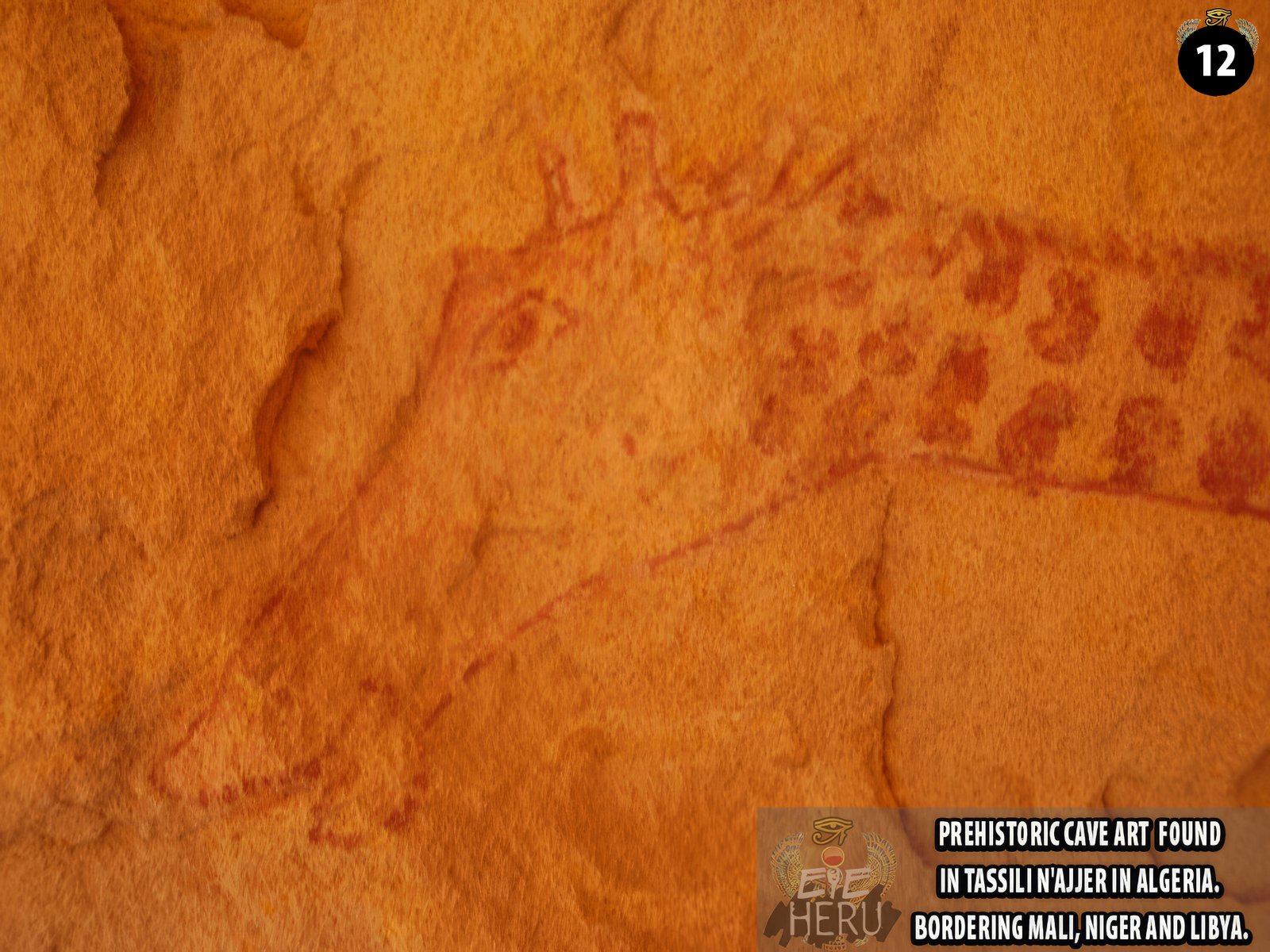
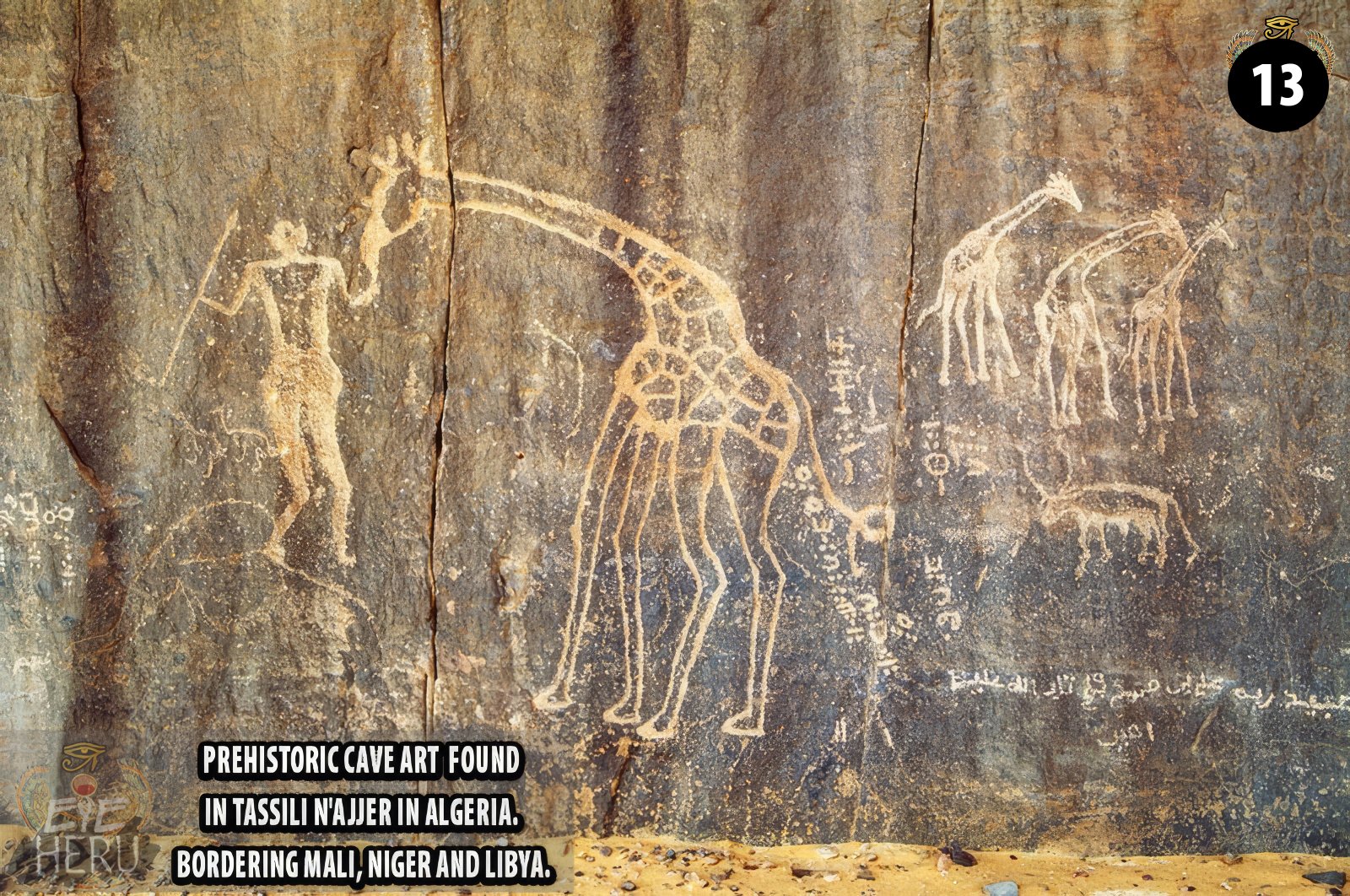
The rest of the images I gathered. Read them knowing what you now know, these are not all from one moment. They span thousands of years of people living in a Sahara that was green, and then watching it close.


Wrapping It Up: The First Chapter of Egypt’s Story
The Paleolithic period may be where the story of Ancient Egypt truly begins. It’s a time of migration, survival, and shared culture that laid down the foundation for one of history’s greatest civilizations. These early groups didn’t just settle the Nile Valley, they set the stage for dynasties, monuments, and innovations that would shape the world.
And the more I dig, the clearer one thing gets. The story does not start at the river. It starts out in a green Sahara that no longer exists, with people we are only now beginning to read the DNA of. The Nile Valley is where they ended up, not where they began.
Sources
Salem, N. et al. (2025). Ancient DNA from the Green Sahara reveals ancestral North African lineage. Nature. nature.com
Morez Jacobs, A. et al. (2025). Whole-genome ancestry of an Old Kingdom Egyptian. Nature. nature.com
Sirak, K. et al. (2021). Social stratification without genetic differentiation at the site of Kulubnarti in Christian Period Nubia. Nature Communications. nature.com
Schuenemann, V. et al. (2017). Ancient Egyptian mummy genomes suggest an increase of Sub-Saharan African ancestry in post-Roman periods. Nature Communications. nature.com
British Museum, African Rock Art Project – chronologies and Algeria. britishmuseum.org
UNESCO World Heritage Centre. Tassili n’Ajjer. whc.unesco.org
The Metropolitan Museum of Art. African Rock Art: Tassili-n-Ajjer. metmuseum.org
Institute for the Study of Ancient Cultures, University of Chicago. Nubian Archers. isac.uchicago.edu
Wendorf, F. & Schild, R. Nabta Playa and its role in Northeastern African prehistory.